
Last updated September 20, 2026
Free on-site gate assessment - hinges, posts, and your LiftMaster or Nice gate operator checked before anything is quoted
The assessment is free and the quote is the invoice.

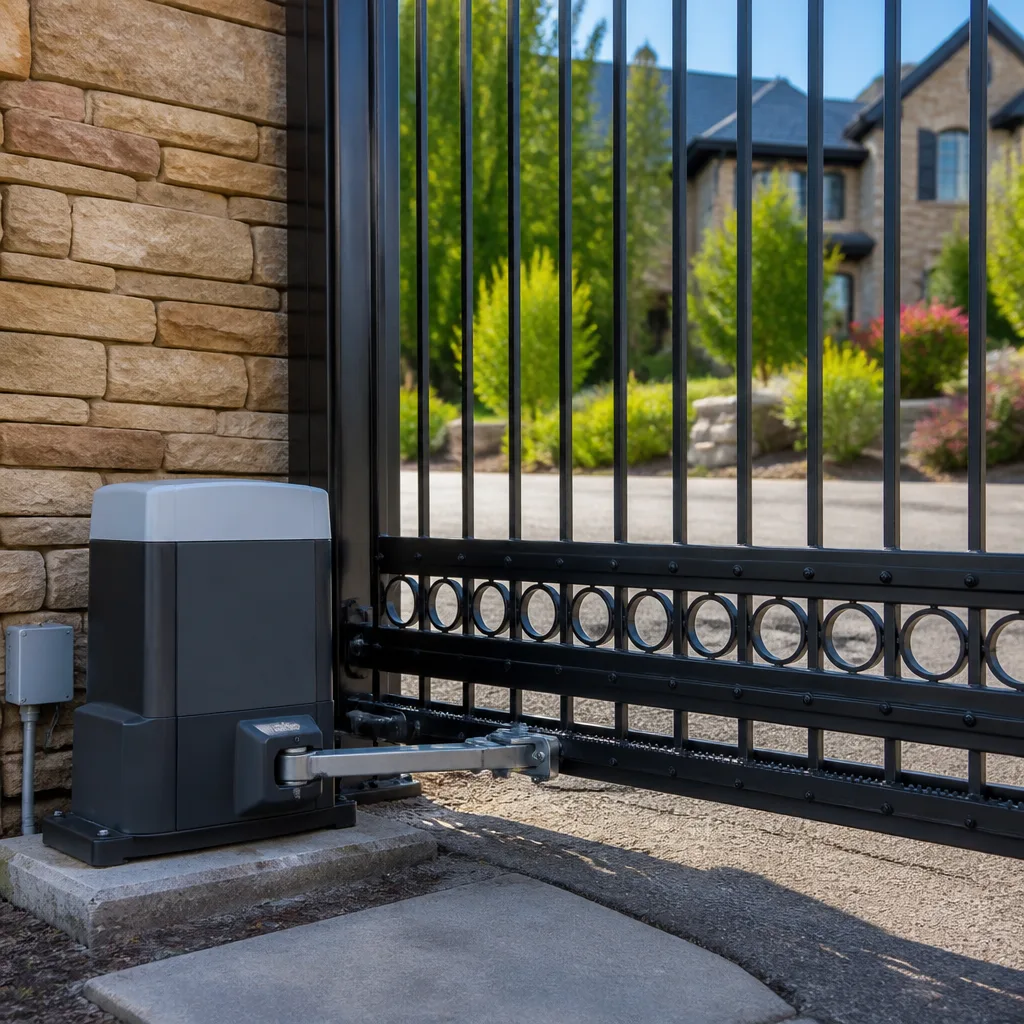
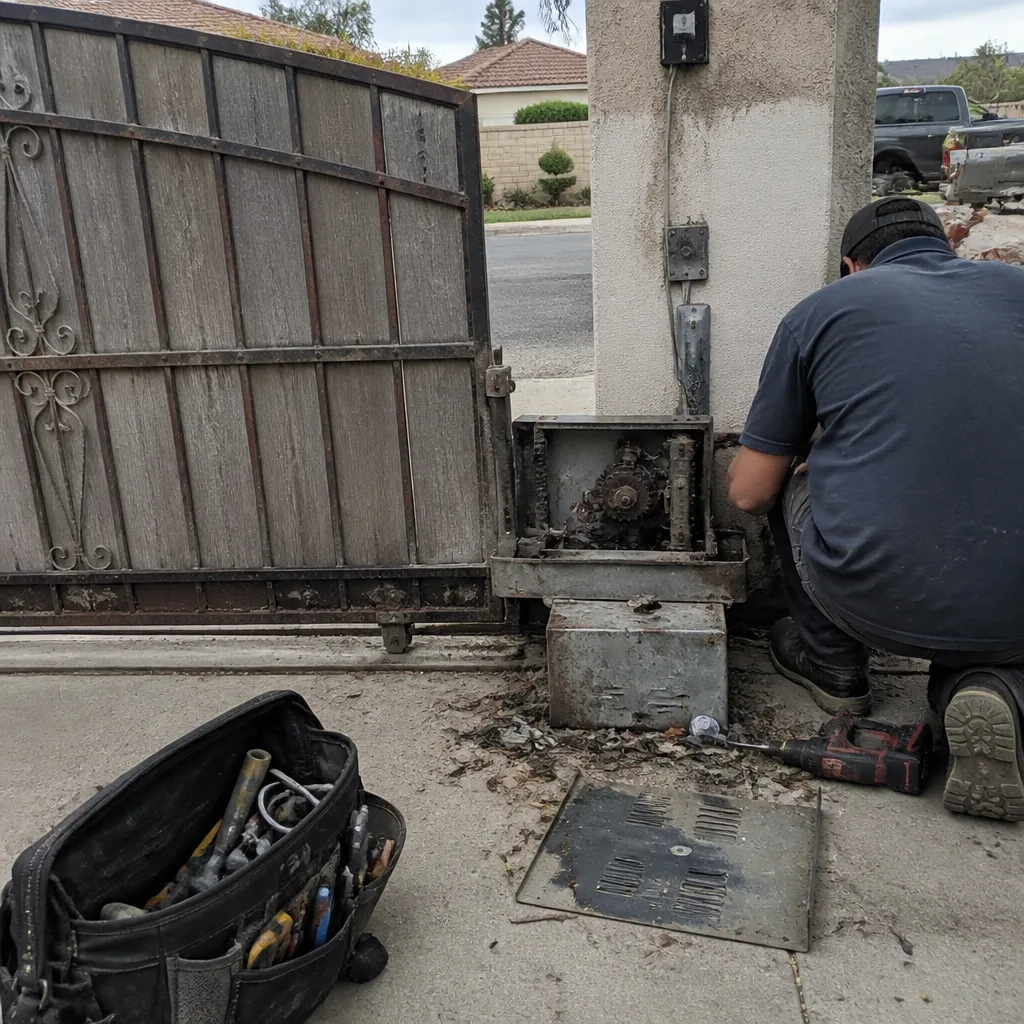 Before
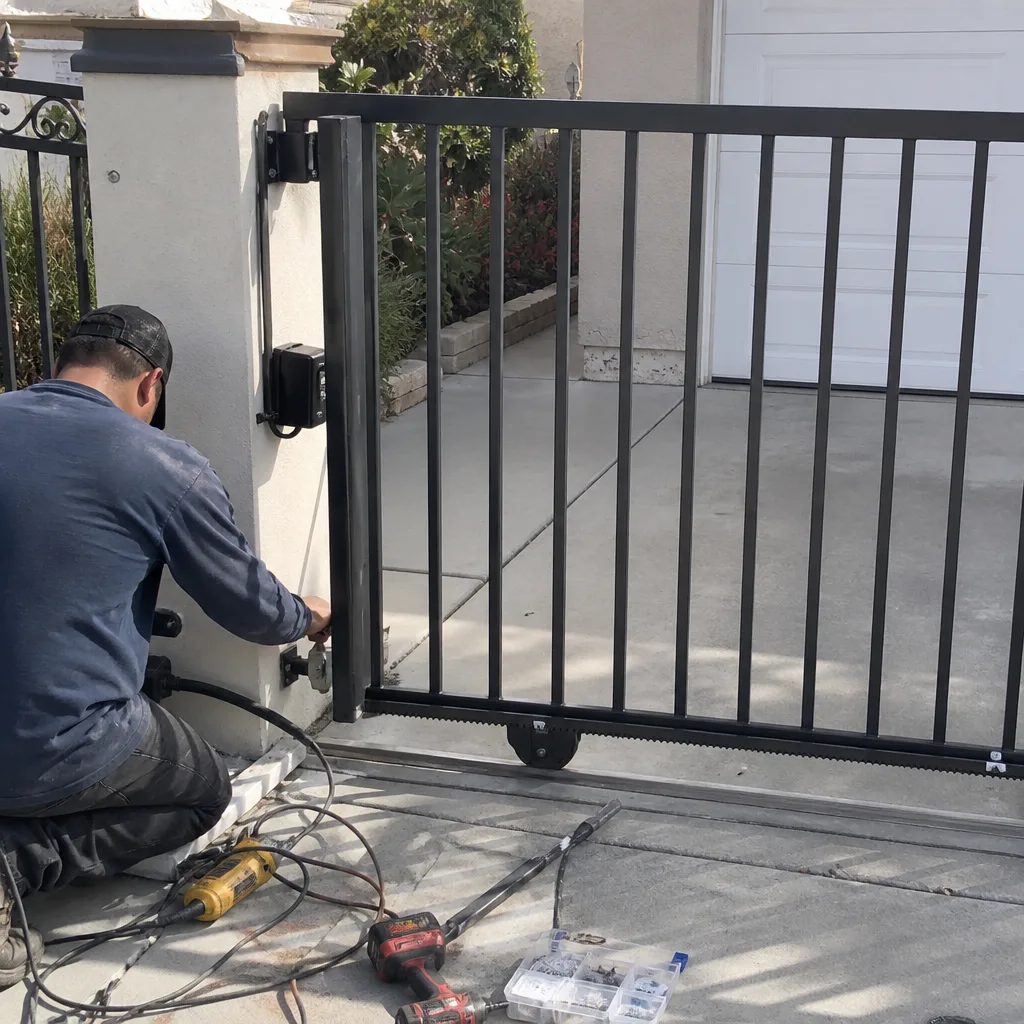 After
After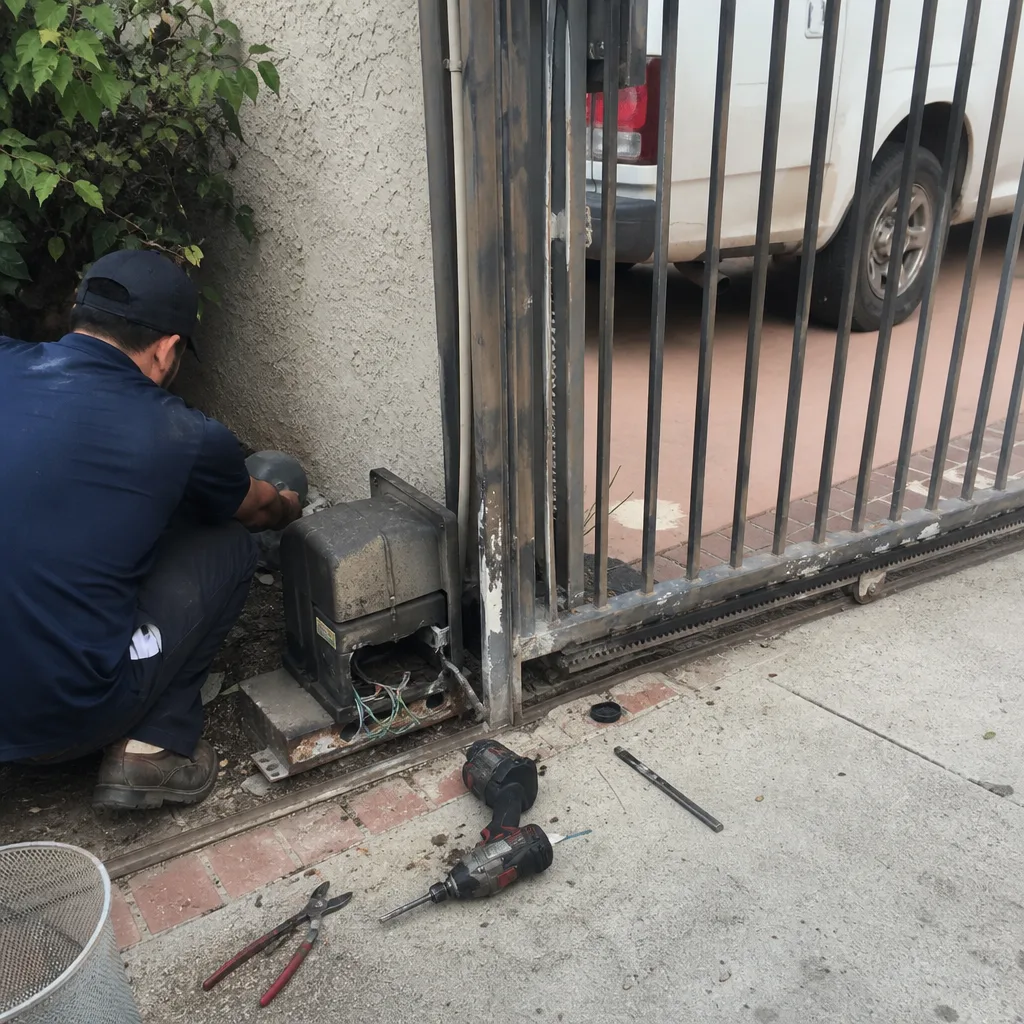 Before
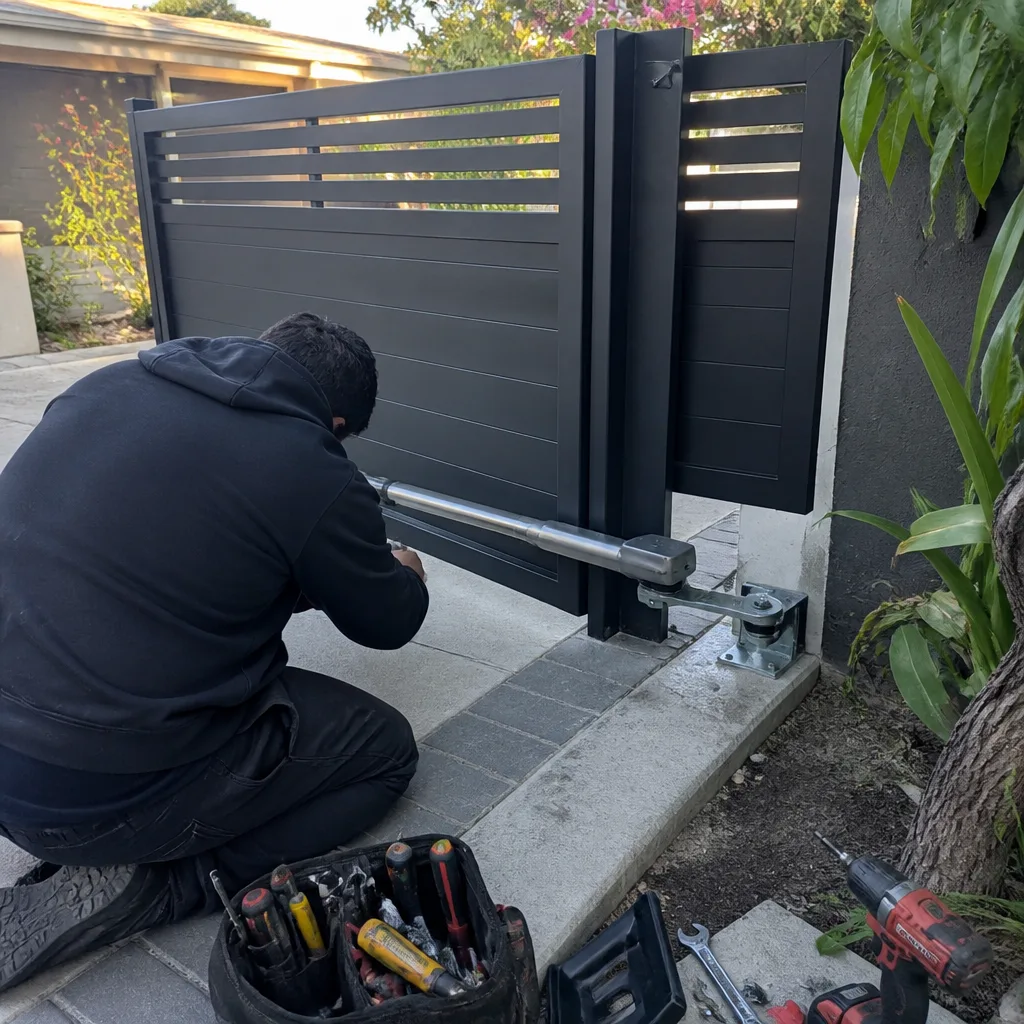 After
After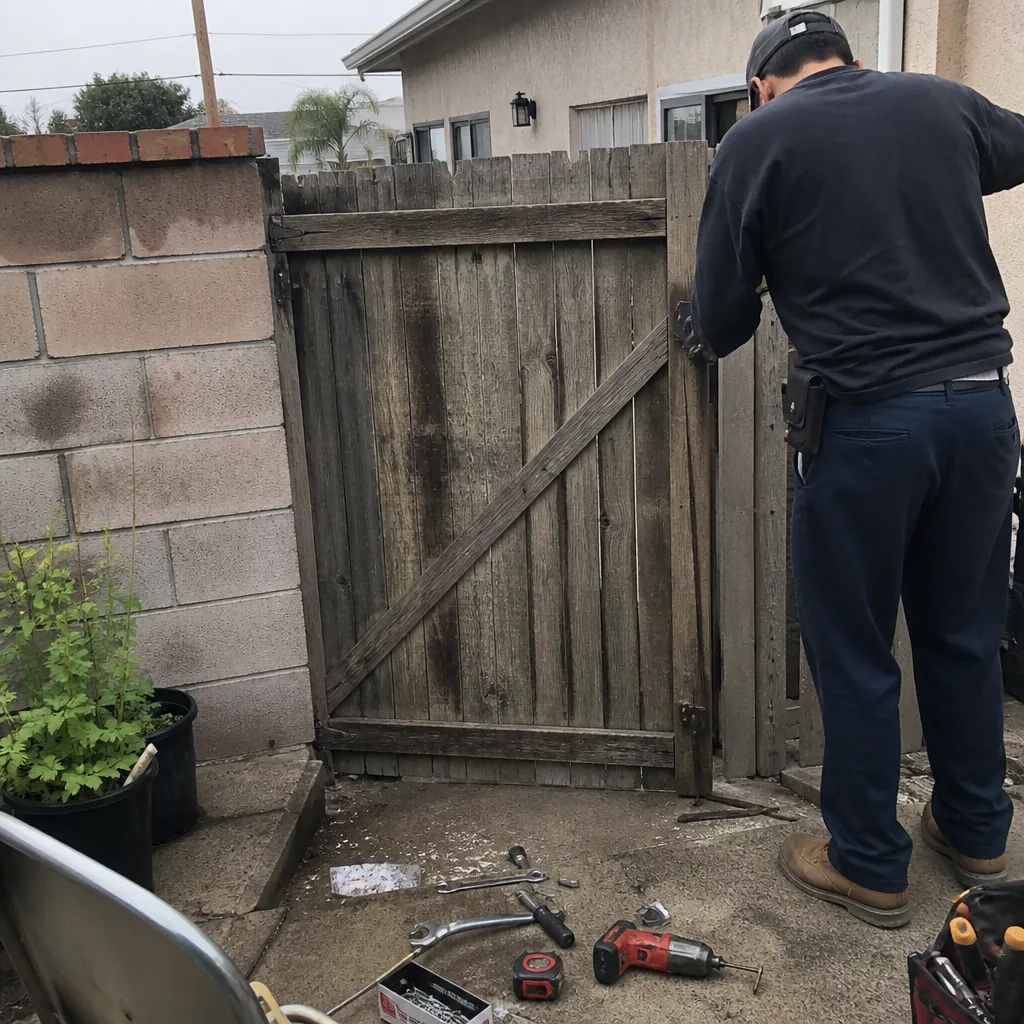 Before
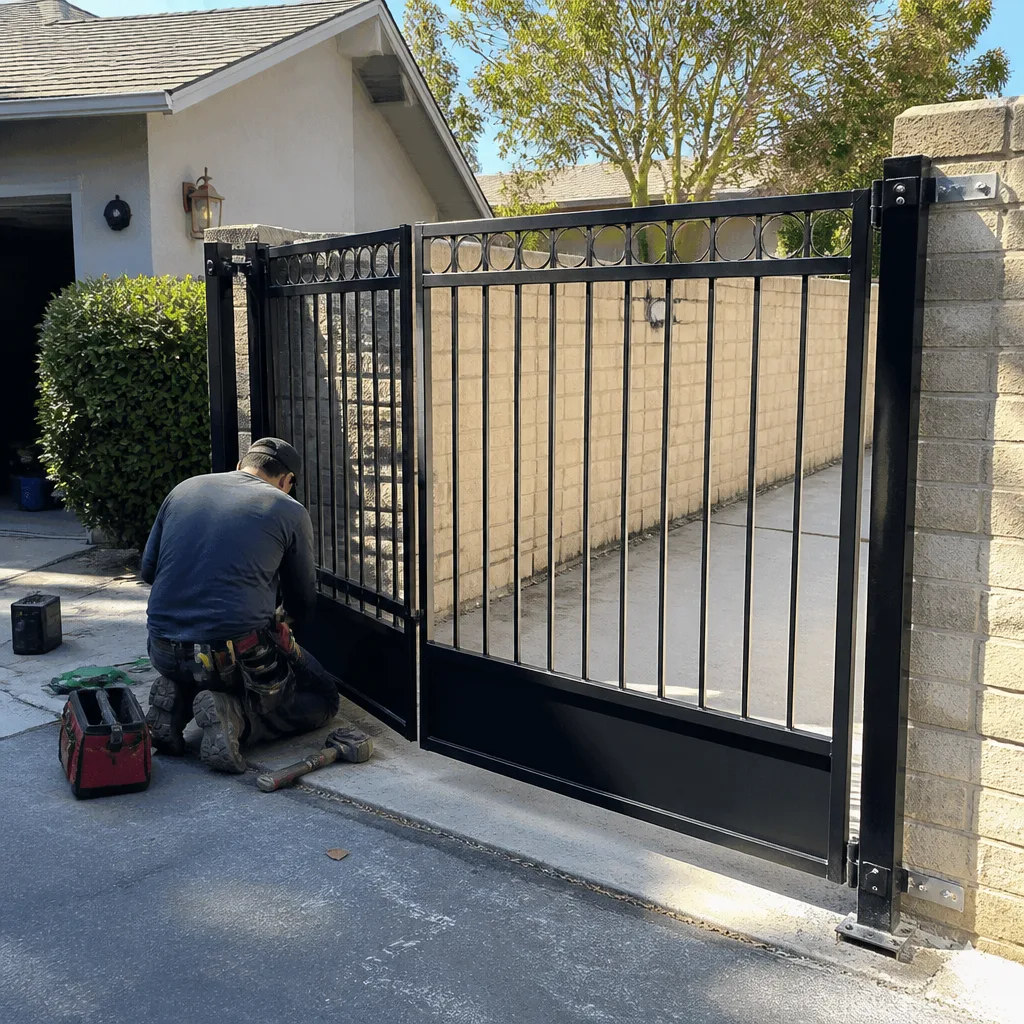 After
AfterDIY vs Professional Gate Repair: The Torrance Homeowner’s Decision Guide
Replacing a gate hinge yourself is a reasonable afternoon. Adjusting the limit switches on a UL 325-regulated automated gate yourself creates an entrapment liability that your homeowner’s insurance may not cover if something goes wrong. That single distinction, not your skill level or your tool collection, is what actually separates the jobs you can handle from the jobs you should hand off. This guide walks you through exactly where that line sits, what it costs when you cross it, and how to approach the handful of diagnostic tasks that are genuinely safe for a prepared homeowner in Torrance. You’ll also learn why the documentation a technician leaves behind matters more than the repair itself.
Quick Answer
For mechanical tasks like hinge lubrication, manual force testing, and visual inspection, a careful Torrance homeowner can often handle the work safely and save a service call. But any repair that touches the automated system, meaning the motor, control board, limit switches, photo-eyes, or wiring, falls under UL 325 entrapment-protection standards and should be done by a trained technician who can verify the gate still meets those safety requirements after the repair. The DIY-versus-professional decision is not about competence: it is about electrical liability and compliance.
Table of Contents
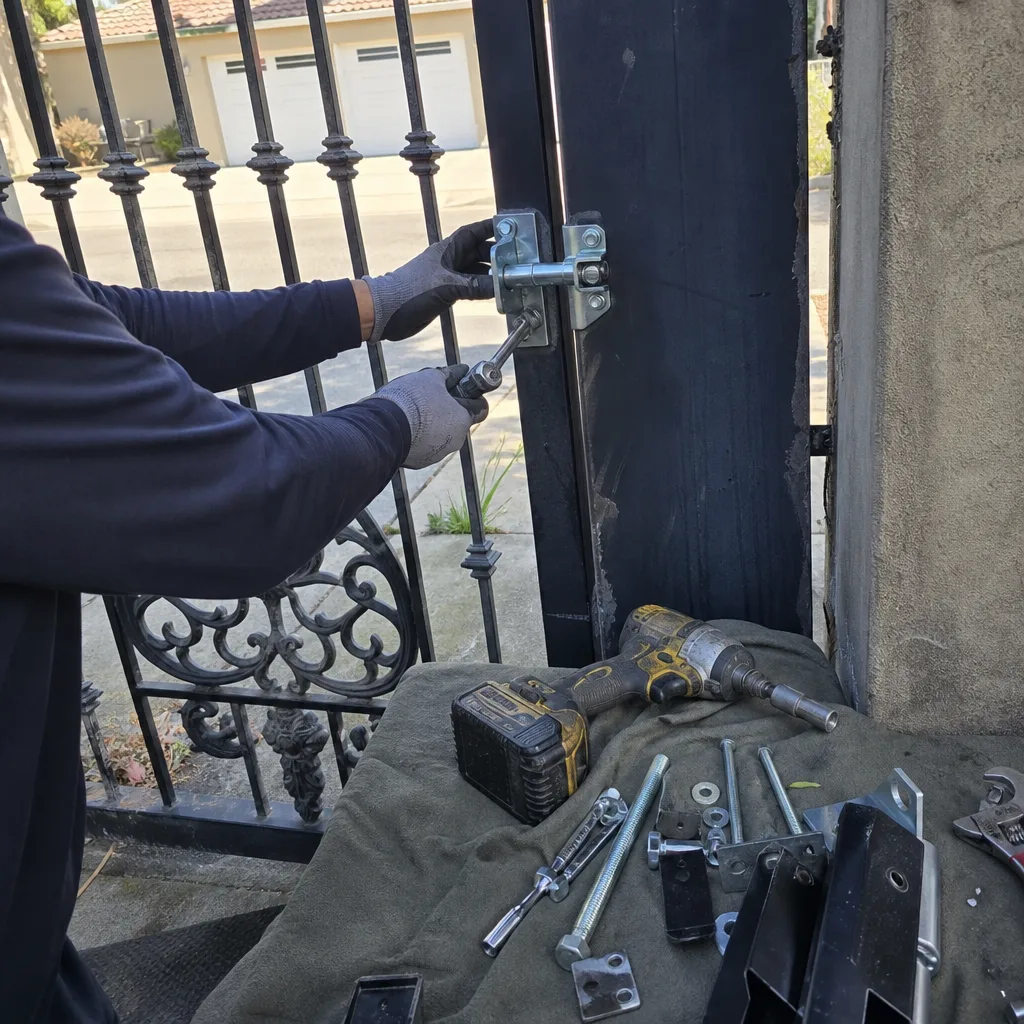
- The Line Between Mechanical and Automated Work
- What UL 325 Actually Requires, in Plain Language
- Four Tasks That Are Genuinely Safe for a Homeowner
- Three Tools That Give You a Real Diagnostic Baseline
- How to Evaluate a Repair Manual or YouTube Tutorial
- What a Botched DIY Attempt Actually Costs
- Torrance-Specific Conditions That Change the Math
- How to Decide, Step by Step
BeforeAfterThe Line Between Mechanical and Automated Work
Most gate repairs fall into one of two categories, and the categories do not overlap. The first is mechanical: hinges, rollers, track alignment, the physical gate leaf itself, the chain on a slide gate, the wheels, the brackets. The second is automated: the motor, the control board, limit switches, photo-eyes, loop detectors, wiring, transformers, and anything that sends or receives an electrical signal. In our experience across Torrance, from the hillside lots off Hawthorne Boulevard to the flat residential streets north of Del Amo Fashion Center, most homeowners underestimate which category their problem sits in. A gate that drags on the ground sounds mechanical, but if the drag is caused by a limit switch that was set 12 degrees past travel, the repair is automated.
Here is the working rule: if the fix requires a wrench, a grease gun, or a socket set, and the gate has no motor, you are looking at mechanical work. If the gate has an opener and the problem involves any component that plugs in, connects to a terminal, or carries low-voltage signal, you are now inside the automated system. The distinction matters because professional gate repair in Torrance treats those two categories with different tools, different liability, and different documentation. A hinge replacement does not affect entrapment protection. A limit-switch adjustment does. That is the entire decision in one sentence.
The National Association of Home Builders has noted that automated gates are one of the few home systems regulated by a federal safety standard that homeowners rarely read. That standard, UL 325, is what changes the conversation. Mechanical repairs sit outside it entirely. Automated repairs sit squarely inside it. If you only remember one thing from this guide, remember that boundary.
What UL 325 Actually Requires, in Plain Language
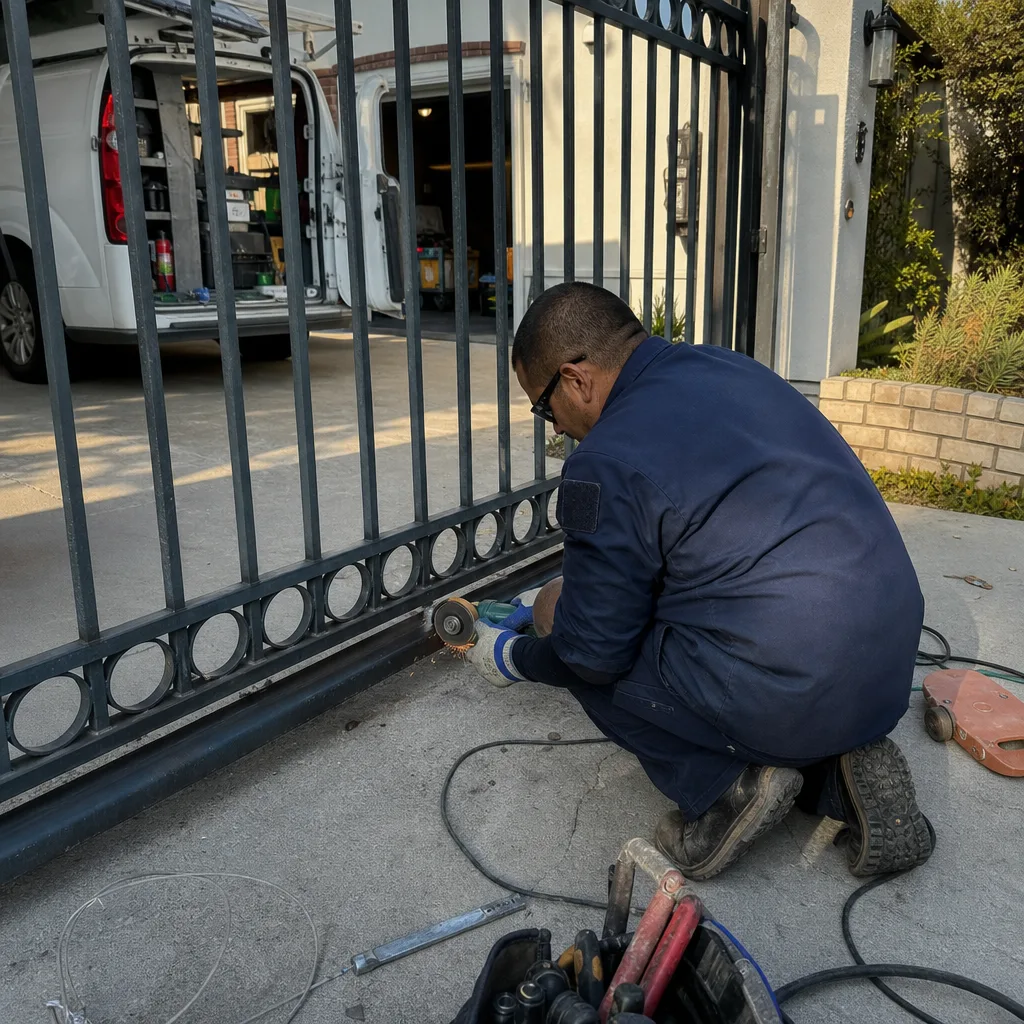
UL 325 is the safety standard that governs automated gate operators and other automated entrapment systems in the United States. It exists because automated gates have killed people: children and adults pinned between a moving gate and a fixed post. The standard was written in response to those fatalities, and it is enforced not by a government inspector but by liability. When an automated gate injures someone, the first question an investigator asks is whether the gate’s entrapment protection was functioning and compliant at the time of the injury. If a homeowner modified that system without verifying compliance, the homeowner may be personally exposed.
Entrapment protection in practice means two things on a residential gate. First, a photo-eye, which is the infrared beam that tells the gate to stop and reverse if something crosses its path while the gate is moving. Second, an inherent entrapment sensor in the motor itself, which detects abnormal resistance on the gate leaf and reverses direction before enough force builds to cause injury. Both systems are calibrated to specific tolerances. When a technician adjusts a limit switch, changes a motor, or replaces a control board, they are legally obliged to verify that both entrapment protections still function within the standard’s parameters. That verification requires a force gauge, which is a calibrated instrument that measures closing force in pounds. It is not a tool most homeowners own, and it is not something you can approximate by hand.
The practical implication for Torrance homeowners is straightforward. You can replace a hinge without thinking about UL 325. You cannot adjust a limit switch, replace a control board, or rewire a photo-eye without triggering the compliance question. And if you do that work yourself and the gate later injures a child, your homeowner’s insurance carrier may deny the claim on the grounds that an unqualified party modified a regulated safety system. That is not speculation: standard homeowner’s policies contain exclusions for bodily injury arising from unlicensed modifications to automated entrapment-protection systems. We’ve seen Torrance homeowners learn this distinction the hard way.
Four Tasks That Are Genuinely Safe for a Homeowner
There is a real, legitimate role for homeowner maintenance, and doing it well extends the life of your gate and reduces the frequency of paid service calls. The key is staying on the mechanical or observational side of the line. Here are four tasks that are safe when done with basic care.
- Lubrication of hinges, rollers, and chains. Use a lithium-based grease on metal-to-metal contact points and a lightweight silicone spray on the gate track. Do this twice a year in Torrance, ideally before the rainy season and again in late spring when the marine layer fades. Avoid petroleum-based lubricants on nylon rollers, which are common on modern residential gates.
- Manual force testing. With the opener disengaged, ideally by pulling the manual release handle, push the gate open and pull it closed by hand. It should move with steady, even resistance and no binding. If you feel a catch at any point, stop and note where it is. That is a diagnostic finding, not a repair task.
- Visual inspection of hardware. Once a season, walk the gate and look at every bolt, bracket, roller, hinge, and weld. Torque or tighten anything that has loosened. Look for rust on steel components, especially near the bottom of the gate where irrigation overspray is common in Torrance yards.
- Basic remote troubleshooting. If your remote stops working, replace the battery first. If that does not fix it, check whether multiple remotes fail or just one. A single failed remote usually means the remote itself, not the receiver. That observation will save a technician diagnostic time later.
None of these tasks require touching the motor, the control board, the photo-eyes, or any wiring. None of them trigger UL 325 concerns. All of them produce useful information. In fact, one of the most valuable things a homeowner can do before calling anyone about a gate problem is to complete these four tasks and write down what they find. That record becomes the starting point for a professional diagnosis, and it often cuts the service visit in half.
Three Tools That Give You a Real Diagnostic Baseline
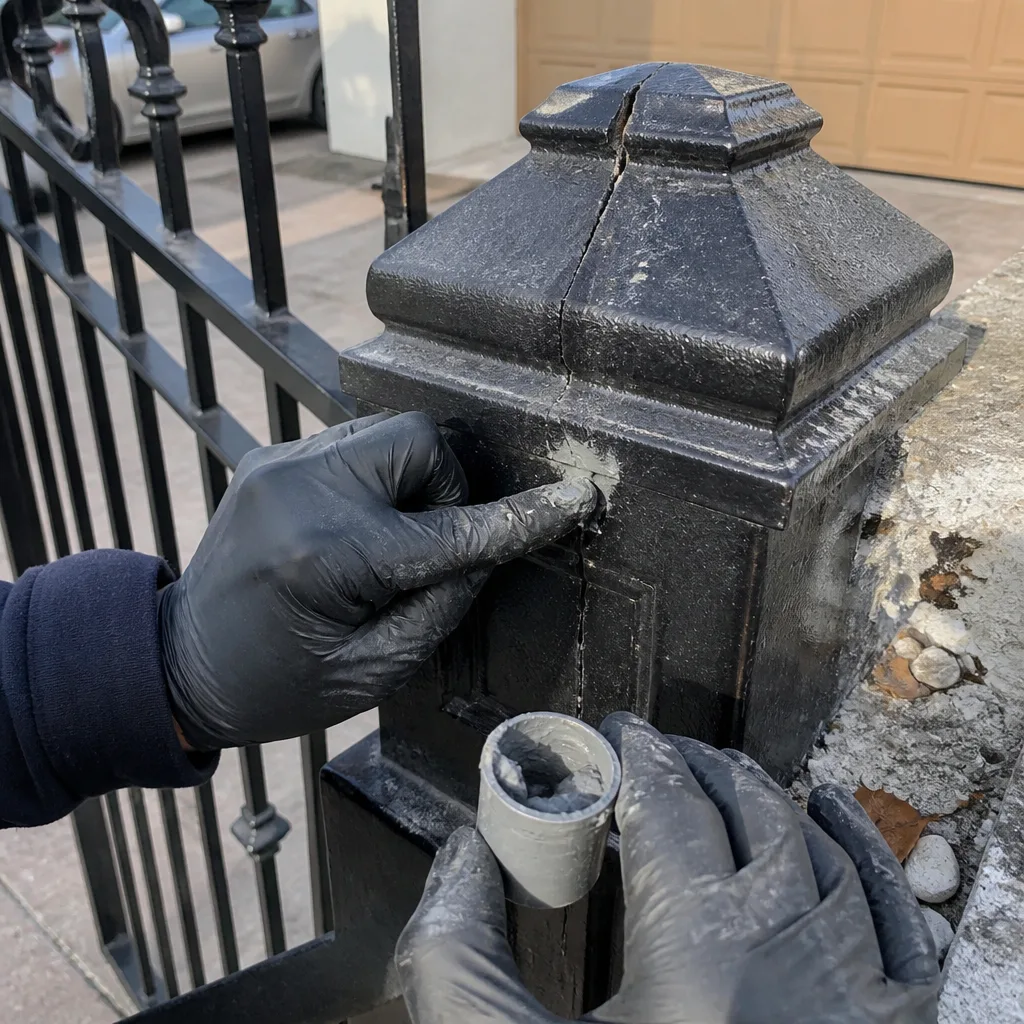
If you want to go one step beyond the basic four tasks, there are three tools that let you safely diagnose, meaning observe and measure, your automated gate without modifying anything. These tools will not fix the gate, but the readings they produce are exactly what a technician would gather in the first 20 minutes of a service call. Having the numbers ready before you call can meaningfully reduce the diagnostic labor, and with gate motor and opener service in Torrance, that translates directly to a shorter visit and a tighter invoice.
- A digital multimeter. This measures the voltage at the control board terminals and the continuity across the photo-eye relay. A homeowner who can read 24 volts DC at the board but zero volts at the photo-eye has already isolated the problem to the wiring between those two points. You are not repairing anything: you are narrowing the search radius, which is what diagnostic work actually is. A decent multimeter costs $30 to $60.
- A manual release key or handle. Every automated gate is required to have a manual disengage mechanism, and knowing where it is and how it operates is a safety necessity, not just a diagnostic tool. If your gate loses power while closed, you need to know how to get your car out. While the gate is disengaged, you can run the manual force test described above and feel for mechanical binding that the motor might be masking.
- A phone camera with a flash, or a small mirror. Many gate faults are visible only from below or behind the motor housing, where the limit-switch assembly and wiring terminals sit. A photograph of those components, even a bad one, gives you something to describe when you call a repair company. It also creates a record. A homeowner who can say “the white wire on terminal 3 looks charred” has given a technician an enormous head start.
The point of these three tools is not to turn you into a gate technician. It is to make you a better-informed customer, and a better-informed customer is someone who can evaluate a quote, ask the right questions, and recognize when a repair company is doing good work versus doing fast work. In a city the size of Torrance, with the number of gate companies operating here, that distinction alone is worth the price of a multimeter.
How to Evaluate a Repair Manual or YouTube Tutorial
There is a lot of gate repair content online, and some of it is genuinely useful-see our more guides & resources for locally relevant advice. There is also a lot of content made by people in other climates, in other countries, or with gate systems that are not legal to install in the United States. Before you follow any tutorial, there are two questions to ask. They will filter out most of the bad advice in under a minute.
Question one: does this tutorial show the work being done on a UL 325-compliant system, and does it mention entrapment protection at all? If the video skips from “remove the cover” to “adjust the limit switch” without mentioning photo-eyes, force settings, or the reason the limit switch position matters for safety, you are watching an incomplete procedure. The person making the video may have gotten their gate working, but they may also have left a gate that will not reverse when a child is in the path. A tutorial that does not mention entrapment protection is a tutorial that is not safe to follow for automated work.
Question two: does the tutorial’s context match Torrance’s conditions? Much of the gate maintenance content online is produced in desert climates, where dust is the primary wear factor, or in humid coastal climates, where corrosion is the constant enemy. Torrance sits in a specific band: cool marine air off the Pacific, low rainfall, occasional salt spray depending on proximity to the coast, and fine particulate from the refineries and the 405 corridor drifting over the eastern neighborhoods. That combination produces a particular kind of wear pattern, mostly oxidation on electrical terminals and fine grit accumulation in motor housings. A tutorial that assumes a dry, dusty environment is giving you advice that may not match what you are looking at on your own gate.
One more practical test: does the tutorial tell you what to do when the repair does not work? If it does not, it is not a repair procedure, it is a script. Real repair work involves branching: if this does not fix it, check that. A tutorial that only works if everything goes as expected is not preparing you for the conditions on a 10-year-old gate in Torrance. And a Torrance gate that is 10 years old has been through a decade of marine air, which is a real thing.
What a Botched DIY Attempt Actually Costs
The number most homeowners never see is the cost of diagnostic time added when a technician encounters an undocumented modification. When a gate has been taken apart and reassembled by someone who did not fully understand the system, the technician does not simply pick up where the homeowner left off. The technician has to first verify what the homeowner changed, then undo it if needed, then diagnose the original fault, then repair it, then re-verify UL 325 compliance. That is not a linear process; it is a rework process.
Here is what that looks like in dollars on a typical Torrance service call. Standard diagnostic labor for a gate operator fault in this market usually runs between $95 and $145 for the first hour, depending on the company and the time of day. If the technician can isolate the fault quickly because the gate is in its original documented state, the diagnosis might take 30 to 45 minutes. If the same technician arrives to find that the homeowner has already replaced the limit switch, re-terminated the wiring, and adjusted the closing force with a screwdriver, the diagnostic phase often balloons to 90 minutes or more, because the technician now has to verify every one of those changes before trusting any reading. That is an additional $50 to $75 of diagnostic labor, before any actual repair work begins.
Then there is the parts cost. A homeowner who purchases a replacement control board online because it was cheaper than the quote they received sometimes installs a board that is not compatible with their motor brand or their photo-eye configuration. The board gets damaged, the motor may get damaged, and now the repair costs more than it would have originally. We have seen cases in Torrance where a $40 attempted DIY replacement turned into a $600 full board and motor service, because the incompatible board fed the wrong voltage to the motor windings. The math on DIY savings only works if the repair succeeds on the first attempt. When it does not, and it often does not on automated systems, the downstream cost exceeds the original quoted repair price.
There is one more cost that is harder to quantify: documentation. When a homeowner modifies their own gate, there is no record. When a professional gate installation or repair in Torrance is done under our process, there is a written price before the work starts and a documented photo record when it finishes. That record shows what was found, what was adjusted, and what was installed, with part numbers. Future repair work becomes faster and cheaper because no one has to rediscover the same problem. A homeowner who goes the DIY route not only risks the immediate repair, they sacrifice that cumulative documentation.
Torrance-Specific Conditions That Change the Math
Gate repair is not the same job in every city. Torrance has specific conditions that affect how gates wear, what fails, and how much of a DIY project is realistically achievable. Understanding these local factors helps you evaluate whether a repair is worth attempting or whether the conditions are already working against you.
Marine air and terminal corrosion. The closer your property sits to the Pacific, the more your gate’s electrical terminals are exposed to salt-laden air. That exposure produces a thin oxide layer on copper terminals, which increases resistance and causes intermittent faults that are notoriously difficult to isolate. A homeowner with a multimeter can sometimes identify a corroded terminal, but properly cleaning and re-terminating low-voltage control wiring without damaging the board is delicate work. The oxidation problem in Torrance is not hypothetical: it is the single most common electrical fault we see on gates within two miles of the coast.
Sloped driveways. A large portion of Torrance, especially in the Hollywood Riviera and along the Palos Verdes boundary, sits on graded terrain. Gates on sloped driveways operate under constant gravitational load in one direction, which accelerates wear on hinges, rollers, and motor gears. A gate that would be perfectly balanced on a flat street in central Torrance may be chronically overworking its motor on a hillside lot. That means any adjustment to limit switches or force settings on a sloped gate has narrower tolerances and less margin for error, which is exactly the situation where a DIY adjustment is most likely to create an entrapment hazard or a motor burnout.
Particulate from the 405 and industrial corridors. The eastern edge of Torrance, running up against the 405 and the light industrial zones near Western Avenue, sees a steady deposit of fine particulate matter. That grit works its way into motor housings, chain drives, and limit-switch assemblies. The failure mode is usually not sudden; it is gradual binding that gets misdiagnosed as a motor failure. A homeowner who can open the motor housing and photograph the accumulated grit has done useful diagnostic work. A homeowner who tries to clean the motor internals with compressed air from a can has potentially forced grit deeper into the bearings and shortened the motor’s life by a year or more. This is a case where observation is safe and intervention is risky.
How to Decide, Step by Step
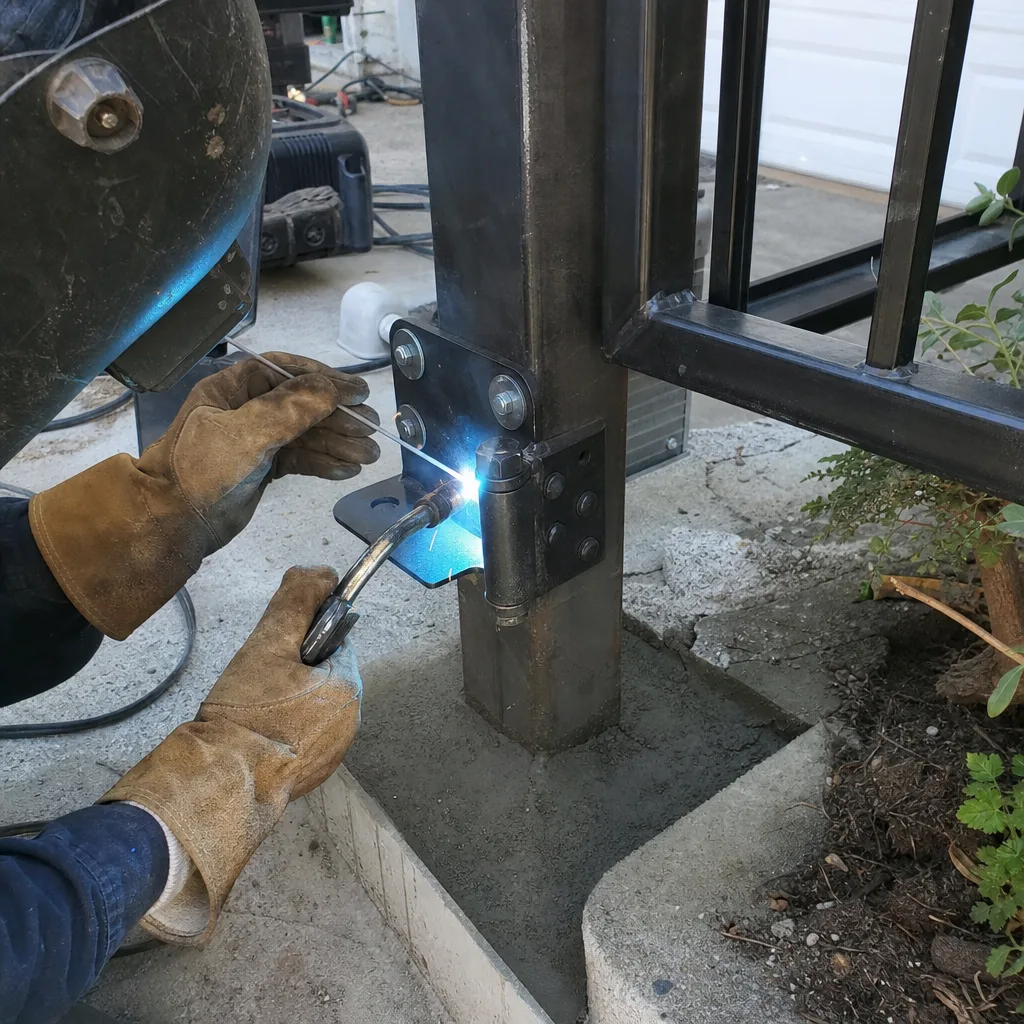
If you have a gate problem in front of you and you are not sure whether to attempt it or call someone, work through this sequence in order. It will get you to the right answer in under 10 minutes.
- Identify whether the gate has a motor. If it does not, everything on this list is mechanical. Proceed carefully with basic tools and call a professional only if you encounter welding, sagging gate leaves, or foundation problems.
- If it has a motor, determine whether the problem involves anything electrical. Does the gate not open at all? Does it open but not close? Does it reverse in the middle of the cycle? Does the remote not work? All of those are automated-system problems. Stop. Do not proceed with DIY repair.
- Run the four safe tasks. Lubricate, force-test, inspect, and troubleshoot the remote. Document what you find. If the problem persists after those tasks, you have eliminated the most common mechanical causes and gathered useful diagnostic information.
- Take photos. Photograph the control board, the motor housing, the photo-eyes, and any visible damage or wear. These photos become the record you describe when you call a repair company.
- Call and describe what you found, not what you think it is. A useful description is “the gate opens fully but reverses halfway through closing and the photo-eye light is blinking” rather than “the motor is broken.” The first sentence gives a technician a working hypothesis. The second gives them nothing.
- Ask for a written price before scheduling. In Torrance, there are companies that will write the price down before any work starts, and companies that will not. Choose the one that will. The price should include diagnostic labor, parts, and the repair labor as a single flat number, not an estimate subject to change.
This sequence keeps you on the safe side of the UL 325 line while still giving you meaningful work to do. It also means that when you do call a technician, you are calling with a documented, observed, specific problem, which is the single fastest way to get an accurate diagnosis and a fair price. The goal of this guide is not to take work away from repair professionals. It is to make sure that when you do need one, the interaction is efficient, transparent, and documented.
Common Mistakes to Avoid
- Adjusting the closing force to fix a reversing gate. A gate that reverses mid-cycle is usually experiencing either a photo-eye misalignment or a mechanical bind. Increasing the closing force to push through the bind creates an entrapment hazard and often burns out the motor. This is the single most common DIY mistake we see on Torrance gates, and it directly triggers the UL 325 liability question.
- Cleaning the control board with contact cleaner. Contact cleaner is for individual terminals, not populated circuit boards. Spraying a board can dissolve conformal coatings, bridge traces, and ruin the board permanently. A $4 can of contact cleaner turns a $30 repair into a $300 board replacement.
- Assuming any 24-volt transformer will work. Gate control boards have specific transformer requirements for voltage and amperage. Installing an under-rated transformer from an electronics store causes intermittent resets and board damage. The transformer spec is printed on the board, and getting it right matters.
- Watching a tutorial from a gate with a different motor brand and applying it to yours. Limit-switch adjustment on a LiftMaster is not the same as on a FAAC. A homeowner who follows a LiftMaster tutorial on a BFT motor will set the limits wrong and may damage the motor. Always confirm the tutorial matches your exact motor model, not just your gate type.
- Leaving the manual release disengaged after testing. A gate left in manual mode can be pushed open by wind, which in Torrance’s stronger gusts can send a gate leaf into a parked car. Always re-engage the opener after testing and verify that the motor moves the gate normally.
- Not checking whether the photo-eyes are even wired in. Some older Torrance gates were installed before photo-eyes were standard, or the photo-eyes were disconnected during a previous repair. If your gate closes on an object without reversing, you may have no working entrapment protection at all. That is not a DIY fix; that is a call-immediately situation.
When to Call a Professional
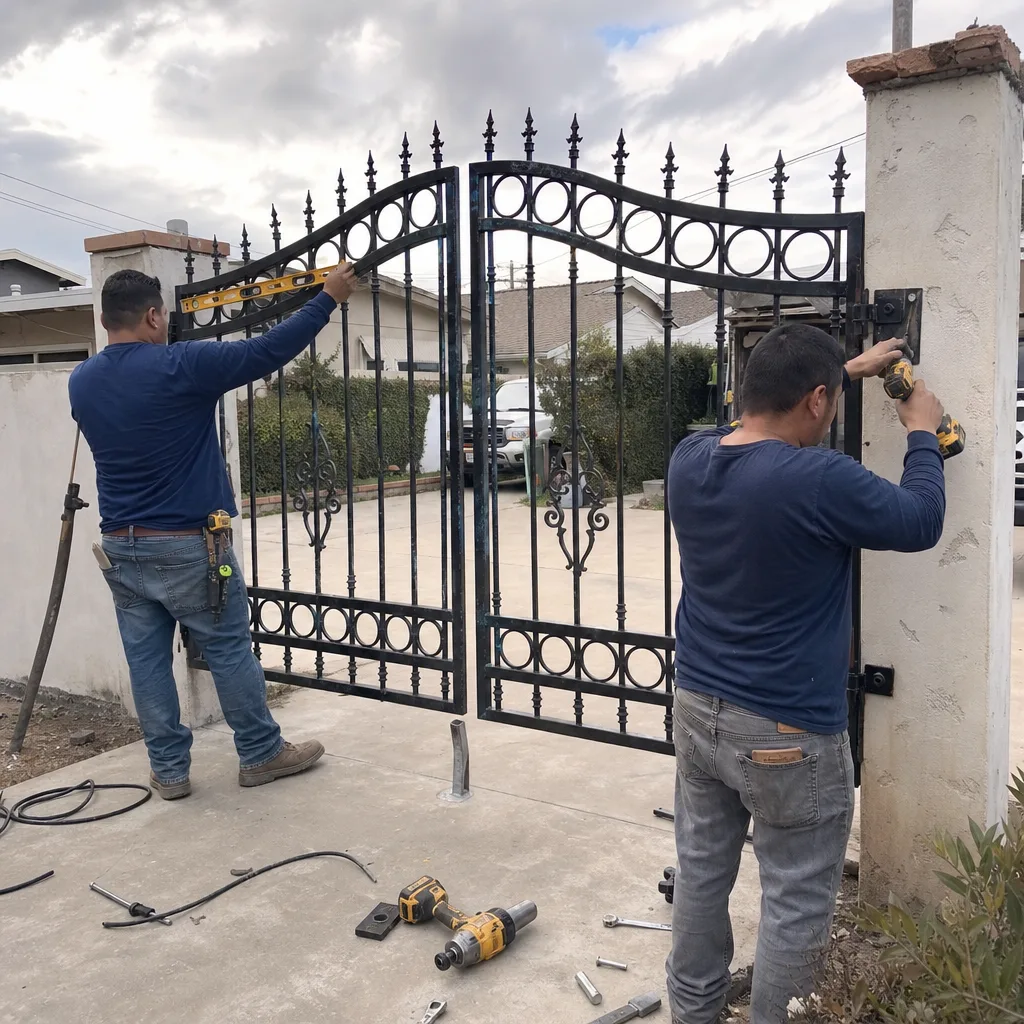
Any fault inside the motor housing, the control board enclosure, or the photo-eye wiring is a professional repair. Any adjustment to limit switches, force settings, or entrapment protection is a professional repair. Any repair that requires a ladder to reach the motor, and many Torrance gates have motors mounted high on the gate frame where a fall would be dangerous, is a professional repair. And any repair where you have already spent an hour and do not know what the problem is, is a professional repair. At that point, the diagnostic work you have done is valuable, and the fastest path to a solution is to hand it to someone who has seen the same fault a thousand times. Vance Gate Repair Torrance offers our Gate Repair services with free estimates in Torrance, call (424) 373-8425.
Frequently Asked Questions
Mechanical maintenance tasks such as lubricating hinges and rollers, tightening bolts, manual force testing, and visual inspection are legal and safe for a homeowner to perform. Any repair or adjustment that involves the motor, control board, limit switches, photo-eyes, or wiring on an automated gate falls under UL 325 entrapment-protection standards and should be performed by a trained technician. The dividing line is not your skill level: it is whether the component you are touching carries electrical signal or governs entrapment protection.
A successful DIY mechanical repair, such as replacing a hinge or lubricating a track, can save $150 to $250 compared to a service call in Torrance. A failed DIY automated repair, such as an attempted limit-switch or control-board repair, typically adds $50 to $75 in diagnostic labor on top of the original repair cost, because the technician must verify and often undo the homeowner’s modifications before beginning the actual diagnosis. When a DIY attempt damages a motor or board, the total bill can exceed the original quote by $400 to $600.
Limit switches control how far the gate travels in each direction, and an incorrect setting can prevent the gate from reversing when it encounters an obstruction, creating an entrapment hazard. Under UL 325, any adjustment to an automated gate’s travel limits must be followed by a verification that the entrapment protection is still functioning within the standard’s specifications, which requires a calibrated force gauge and specific training. A homeowner who adjusts the limits without that verification may carry personal liability if the gate later injures someone.
Most gate repairs in Torrance do not require a city permit, including motor replacement, control board replacement, hinge replacement, and photo-eye service. New gate installations and substantial modifications to the gate structure, especially on properties governed by an HOA or located along a public right-of-way, may require permits. If you are unsure, call the Torrance Community Development Department or ask your repair company to clarify permit requirements before work begins.
Most mechanical repairs, such as hinge or roller replacement, are completed in 60 to 90 minutes on site. Automated system repairs, including motor or control board replacement, typically take 2 to 3 hours because the technician must complete the repair and then run a full UL 325 compliance test. If parts need to be ordered for a specific motor brand, such as a Linear or BFT control board, the repair may require a second visit a few days later.
Ask whether the price will be in writing before any work starts, whether the technician will leave a written record of what was found and what was installed, and which motor brands the company services so you know they can work on your existing equipment. Ask whether the technician will verify UL 325 compliance after the repair and whether the company provides a written warranty on completed work. A company that can answer all five questions clearly is signaling a documentation-first process, which protects you and makes future repairs faster. Call (424) 373-8425 for a written estimate.
The Bottom Line
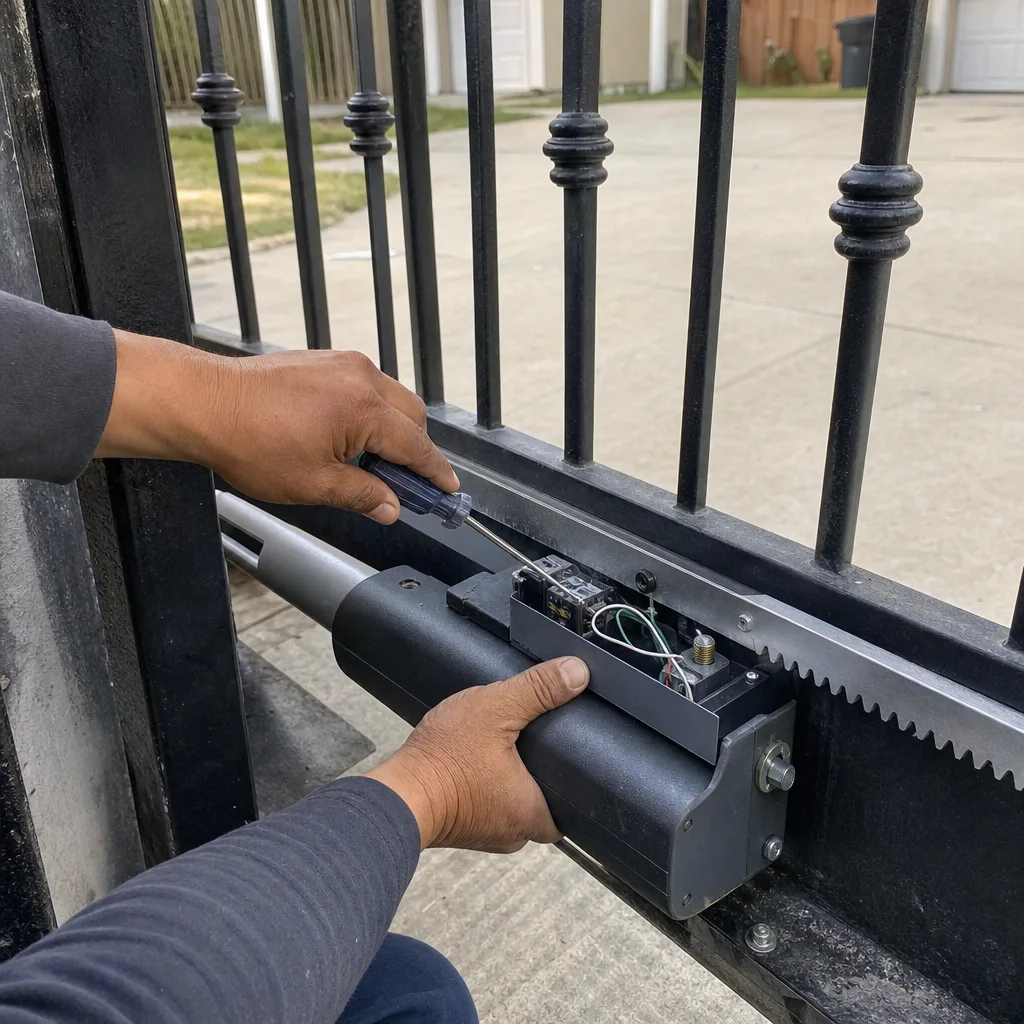
The DIY-versus-professional decision for gate repair in Torrance comes down to a single boundary: mechanical work on one side, automated work on the other. Mechanical maintenance is safe, valuable, and worth doing yourself when you have the basics down. Automated repairs are regulated by UL 325 for a reason, and the liability exposure of getting them wrong is not worth the savings. What matters most, whichever route you take, is that the work gets documented. A repair without a record is a repair you will pay for twice. Vance Gate Repair Torrance has built its entire process around that principle, because it protects the homeowner and it makes every future repair faster and cheaper.
Written by Adrian Vance, Owner at Vance Gate Repair Torrance, serving Torrance since 2014.